Forgotten Cisterns Level Art breakdown
Winner for Best Overall in Manticore's DnD Game Design contest. Forgotten Cisterns is a multiplayer game I made using the Unreal-based Core platform. The environment and props are kitbashed together using primitives and existing assets. Besides kitbashing, I focused my efforts on scripting, lighting, sounds, modifying materials, setting up particle systems, and adding post-processing effects.
Link to the game: https://www.coregames.com/games/c73df3/dungeon
The guild hall acts as a home for the players before they dive in the cold and hostile Cisterns. The hall has warm and welcoming feeling with music playing in the background. Walls are straight to give a sense of order and stability. (toggle sounds)
The Cistern environment in contrast to the guild hall is abandoned, dark and damp with water dripping from the ceiling. Walls are crooked to give a sense of instability. Instead of music there are faint echoes to create dangerous feeling. (toggle sounds)

In order to have a valid source of light I created light emitting crystals that grow out of the walls. I added them to key locations to provide variety in lighting and color. They also guide players subconsciously through the level.
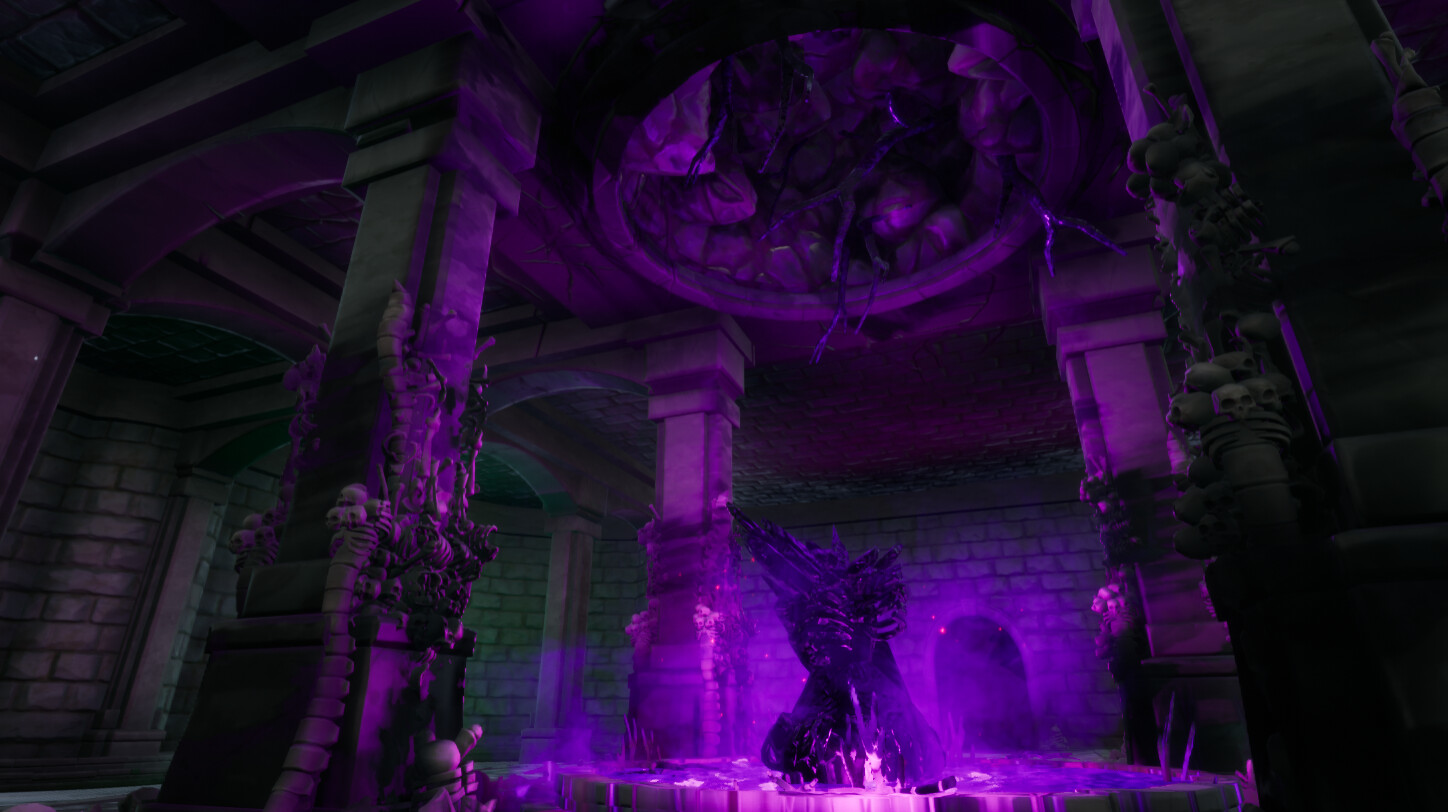
Boss fight area. The boss (in the middle) is made to look morphed and disorienting so that players can't quite pin down what it is. Environment is corrupted with stains and have pointy shapes to indicate danger.

I had one month to make the game so I relied heavily on modular prefabs I built in the editor. These were instanced so I could edit one and all the connected prefabs received the changes. Instancing was important for fast and iterative level creation.

Another life saver was using Core's Smart Materials, which allow textures to align to world space. This enabled me to bundle up geometry without worrying about matching the object UV's.

I used a lot of area lights to fake global illumination while keeping tabs on the performance. The fake GI gave a delicate boost for overall feeling in many places.

Another trick was to fake volumetric light. In practice, it's a simple cone with customized axis-aligned additive material.
Forgotten Cisterns analysed by the competition judges Patrick Buechner and Jordan Maynard, both known by their work on Spore.